
Case study
How I helped Furniture & Décor Brand Go From $891 to $210,400 in E-mail Revenue in One Year

$210,400
Total Revenue Generated
$60,250
Revenue from automated flows
+190%
E-mail database growth
12%
Repeat orders*Previous year at 7%
Challenge: Building an E-mail Channel From Almost Nothing
When I started, e-mail was generating just $891 in total revenue over the entire prior period, with no automated flows in place. On top of that, there was no strategy accounting for the fact that this brand sold two very different products to two very different buyers.
Furniture
Is a considered purchase. Customers browse, compare, save items, and often wait weeks before committing.
Décor
On the other hand, décor is impulse-driven. It’s cheap, fast, and easy to sell if you catch someone at the right moment.
Treating both the same way was the core problem. I set out to build a system that could do both at once: keep long-consideration furniture buyers warm over time, while capturing quick décor sales the moment interest appeared.
What Changed
in 12 Months:
Before implementation
After implementation
All data is from April 2025 – April 2026
Two campaign strategies for two buying behaviors
Rather than running one generic campaign calendar,
I split strategy by product category:
For furniture
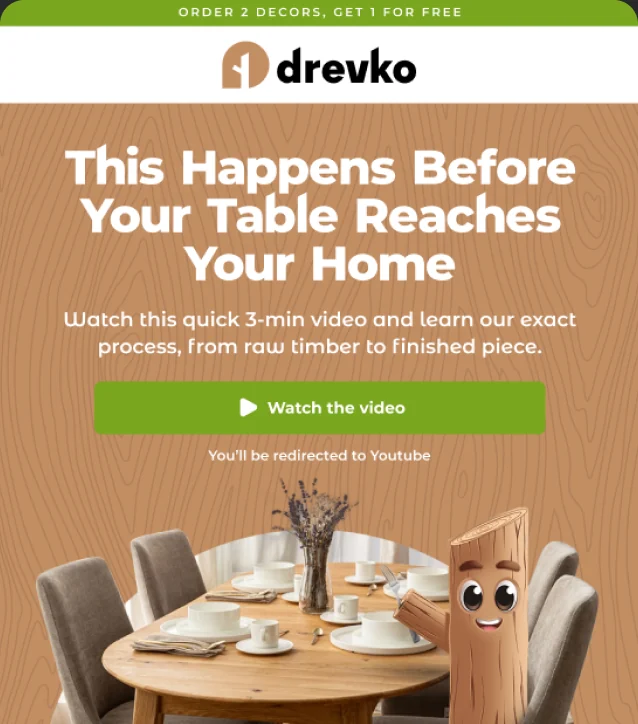
I built content that established trust over multiple touchpoints (social proof) to stay top of mind through a slower decision cycle.
Social proof and trust for furniture
For décor
I ran fast, high-urgency campaigns. These were as simple as 20%-off flash promos that converted quickly and kept short-term revenue flowing while the longer furniture sequences did their work in the background.

Flash promos for décor
Running both in parallel meant the brand had steady cash flow from décor while furniture nurture sequences matured into higher-value sales.
E-mail Automation built on real data
Here’s how one single part of automation generated over $25,400 in 16 months.
Going through the data, I noticed a clear pattern: customers who bought a baby cot were very likely to place a repeat order for something else the child would need. It makes sense - they’re either expecting a baby in a few months, or in a few days or weeks. The challenge was timing the offers correctly around that uncertainty.

The automation shown here isn’t an exact representation of the real flow - but it gives an accurate sense of the logic and structure behind it.
If a customer buys a baby cot without a mattress, we immediately send a promo offering the mattress. This e-mail alone has a high conversion rate, since it’s solving a problem the customer likely just overlooked.
From there, every offer in the sequence is A/B tested - for example, free shipping on the whole order vs. 10% off all mattresses. After a set number of sends and opens, the tool measures results and automatically keeps the version with the higher CTR.
After that first step, we can’t predict exactly when the baby will arrive - it could be days or months away, and every family’s timeline is different. What we do know is that they’ll almost certainly need more nursery items soon: extra storage cabinets, a changing table, a dresser for the baby’s room, and similar pieces. So the rest of the automation is built around that broader window of need, rather than a fixed date.
I took ideas based on assumptions, and built automations off the real data.
This single automation generated over $25,400 over the last 16 months.